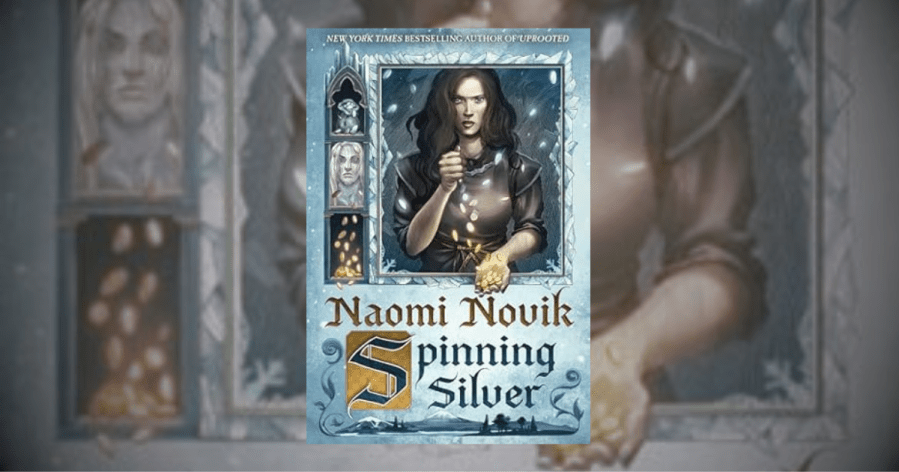
Spinning Silver is set in the snow-swept kingdom of Lithvas, a land ruled by an arrogant tsar and terrorized by the ruthless, otherworldly Staryk. Novik lightly draws inspiration from the Legend of Rumpelstiltskin, a folktale with European roots that shares the lessons to be learned from greed, the pursuit of power, and “getting out of paying one’s debts.”
In her second stand-alone novel following Uprooted, Novik creates a masterful “re-weaving” of the original tale that, like many of the stories collected by the Brothers Grimm, is laden with anti-Semitic prejudices.
The golden-haired miller’s daughter is replaced with clever Miryem, daughter of a Jewish moneylender whose soft-hearted nature mixes poorly with his ability to collect on his investments. As she steps up to take over the failing family business, Miryem must harden herself to be as cold and merciless as the ever-lengthening winters. In her endeavors, she inadvertently draws the attention of a powerful Staryk lord who hears of her ability to “turn silver into gold,” and finds herself trapped in a wager she never intended to make.
Along the way she employs a local village girl named Wanda who quickly becomes entwined in Miryem’s household and adventures. Steadfast and stoic, Wanda works towards her dream of saving enough money to escape her abusive alcoholic father and create a new life for herself and her brothers. Finally, Irina plays a major role as the overlooked daughter of a minor duke whose true potential goes unnoticed even as she is caught up in the schemes of the powerful men around her.
The story is told in the first-person and jumps between multiple narrators including the tsar, Irina’s nursemaid, and Wanda’s younger brother. Rather than a predictable baton pass at the end of each chapter, the narrator would often switch several times within the same chapter without an apparent rhythm which threw me off even more when some narrators picked up the story a beat or two behind where the last scene left off.
While I found myself re-reading some transitions, and periodically muttering, “wait, who’s speaking now?” I also wondered if this play on time and perspective was done intentionally to mimic the overlapping space and time between Lithvas and the magical Stark kingdom. Regardless of the intent, I found it ultimately added subtle details that enriched the story as I was able to experience the same scene from multiple perspectives.
This shifting point of view also contributes to the reader’s understanding of the xenophobia entrenched in Novik’s kingdom “loosely inspired by a mix of Lithuania and Poland and Russia” (Powells.Book.Blog) that seems to be set in medieval times.
We see Miryem and her family carefully move in a world laced with anti-Semitism that leaves them unable to feel safe among their neighbors, their village, and even in their own home. At one point Miryem stoically shares her thoughts on a recent business deal saying, “I didn’t offer to shake hands; no-one would shake hands with a Jew, and anyway I knew it would have been a lie if they had.” We see Wanda’s provincial biases in her initial description of Miryem’s father, who she knows “is a servant of the Devil,” and we also watch as she eventually comes to think of him as family. We see through the eyes of her younger brother Stepon as he observes the customs in a Jewish wedding ceremony with curiosity and wonder. I’ve noticed some readers seem to be shocked by the insidiousness of the anti-Semiticim in the story, but I found myself agreeing more with this interesting article that criticizes Novik for not digging deeper into these complex issues and identities.
As much as I cheered for the women in Spinning Silver, I was equally unimpressed by the toxic masculinity, a reaction that perhaps shows how well Novik captured the harsh reality of this time period’s social norms. However, even as each woman’s choice is stripped from her by the men in their lives, they still defy the expectations placed on them to be a dutiful daughter, puppet, and pawn.
Miryem rejects the gender roles of her society and the criticisms she receives (mostly from other women) for “doing a man’s work.” Wanda refuses to admit defeat even when weighed down by her father’s abuse and her obligation to serve as a maternal figure for her brothers. Irina does not let herself be swept along by her father’s or husband’s plans and instead seizes an opportunity to save her people and exert her influence.
While I loved many elements of Spinning Silver, as with Uprooted, it started to unravel for me towards the end. Why exactly did the Staryk need gold? Why didn’t the king smite Chernobog earlier, when it was apparently not that hard to do? While there were generally answers to these questions, the “why’s” and the “how’s” felt hastily constructed. None of this ruined the story for me by any means but I closed the book feeling like there were a few distracting loose threads.
Despite this, I think fans of Novik’s other work will find it just as breathlessly enchanting as any beloved fairytale. And while there are only subtle hints of romance that blossom at a quiet pace throughout the book, romance is still abundant in this dreamlike world of bitter winters, roaring fires, sleigh rides through dark forests, and the Staryk river gleaming in the distance.
Rating: 4.5 out of 5 stars
Recommended for readers who like: fantasy, magic, stories inspired by fairytales/folktales, Eastern European culture or history.
If you liked Spinning Silver you may also like:
- Uprooted by Naomi Novik
- The Bear and the Nightingale (Winternight Trilogy) by Katherine Arden
- Deathless by Katherine Arden
- More Popular Slovic Folktale Books on GoodReads
 Booklight Reviews