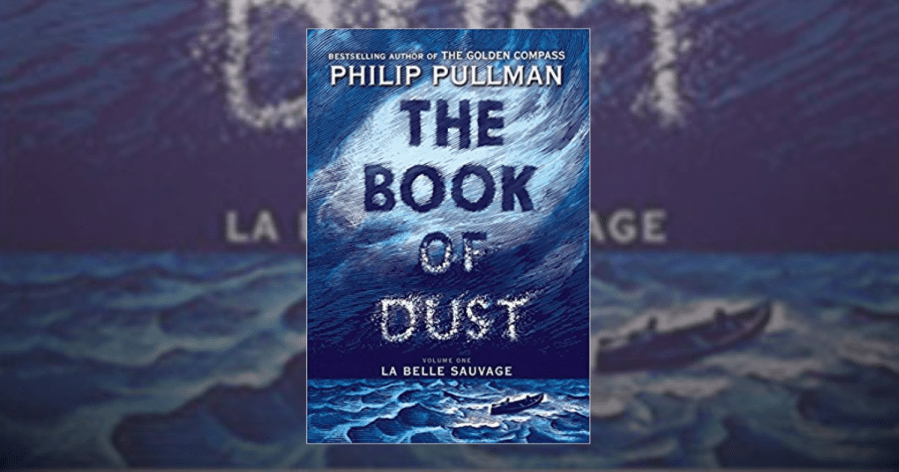
The Book of Dust is a new series by Philip Pullman, and a continuation of another series he completed around 18 years ago called His Dark Materials (you may recognize it by the name of the first book, The Golden Compass which was made into a movie in 2007).
La Belle Sauvage (Book of Dust #1) is also set in Lyra’s world which is a magical version of our own with traces of steampunk technology, where the church rules as shadowy entity known as the Magisterium, and where people’s souls physically manifest outside their bodies in the form of animal companions called “daemons.” However, this story begins years before Lyra’s adventures with Gobblers and the armored Ice Bears of the North, taking us all the way back to when she was just a baby.
Quick
Note: Do you need to read His Dark Materials before The Book of Dust?
No, but I would recommend at least reading The Golden Compass before jumping in, otherwise you’ll encounter some spoilers. The second book in this new series will pick up when Lyra is twenty years old, and before going on to read that you definitely should read His Dark Materials first.
Summary:
The story begins with a new character named Malcolm, an inquisitive and intelligent eleven-year-old boy who works at his parent’s inn called the Trout which is located near Jordan College and about “three miles up the river Thames from the center of Oxford.”
Malcolm is clever and bright, and enjoys listening in on the conversations of various guests who visit the inn’s saloon. Secretly, he longs to be “an astronomer, or an experiential theologian, making discoveries about the nature of things,” but realizes his education and background make this unlikely, and he stoically accepts that he’ll probably take over the inn when his parents can no longer run it.
One day he gets drawn into a mysterious conversation with a man he later discovers to be someone of great importance. Malcolm pieces together the circumstances surrounding baby Lyra who is the center of a scandal as well as the focus of several groups of people, including a secret organization led by the former Lord Chancellor, the Consistorial Court of Discipline (“an agency of the church concerned with heresy and unbelief”) and Gerard Bonneville, a disturbed scientist who was recently released from prison and has a personal vendetta against Lyra’s mother.
Lyra is brought to the Priory of Godstow (aka, a nunnery) located across the river from the Trout for safekeeping where Malcolm meets her during one of his regular visits with the sisters. He is immediately drawn to her and her daemon Pantalaimon and feels a sense of responsibility to look after their well-being. When an unnatural flood sweeps along the region and Lyra’s safety is compromised, Malcolm sets out in his trusty canoe La Belle Sauvage along with Alice, the sullen dishwasher at the Trout, to bring Lyra to the one person he knows can protect her.
My Review
I really enjoyed La Belle Sauvage, but it’s a very different world than what readers may have loved about Lyra’s adventures in His Dark Materials. In the author interview at the back of the book, Pullman acknowledges that it is darker, earthier, and the adventures takes place on a smaller scale.
While Lyra experiences Oxford as a place of “ancient colleges and scholastic rituals and dinner at High Table and beautiful buildings,” Malcolm’s Oxford is seen from outside of the city, and outside of the privileged world of upper-class academia. Instead, the story is told from his perspective coming from a modest, working-class family.
The vibe of this book reminded me of the earthy Anglo-Saxon gods and mythology in the Chronicles of Narnia. At first this felt out of place in Lyra’s world as I had come to know it in His Dark Materials, but after reading Pullman’s interview I think it fits perfectly with Malcolm’s journey which is very connected to the elements.
One of the main elements was of course the river, which really created a sense of place while also serving as a metaphor for Malcom and Alice’s personal journey – from known to the unknown, safety to danger, innocence to adulthood – in so many ways it was more than a metaphor, it was one of the central characters in the story.
While His Dark Materials has adult themes, The Book of Dust is definitely darker, with more violent and potentially triggering scenes that are disturbing (but not graphic). The coming-of-age and loss of innocence themes were reminiscent of the same journey Will and Lyra began to explore during the The Amber Spyglass, and I found it raw, honest, and some mixture between heartwarming and heartbreaking.
Although heavier in tone, the characters and relationships bring in lightness and tender moments that soften the story. Both Malcolm and Alice are great young protagonists who touched me with their maturity, cleverness, and perseverance, especially in contrast with the corrupt adult politics that sweep around them.
At times I caught myself aching for more of Lyra’s cross-continental adventures, but I also appreciated what Pullman said about this story capturing Malcolm’s view that “there was probably nowhere . . . where anyone could learn so much about the world as this little bend of the river.” In some ways, this story is more genuine and reflective of a young person’s perspective of the world. As a child we seem to grasp how large and mysterious the world is in a way that we may be desensitized to as we grow older.
In all, I think this series is off to a great start, and I’ll never pass up a chance to learn more about the nature of Dust, alethiometers, or the complex relationships between people and their daemon’s.
This is truly some of the best world-building that you can find and I’m looking forward to picking back up with Lyra, Pantalaimon, and hopefully many of the characters I grew to care for in La Belle Sauvage when the second book comes out!
Rating: 5 out of 5 stars
Recommended for readers who like: fantasy, child heroes, Anglo-Saxon mythology, religion or philosophy.
If you liked La Belle Sauvage you may also like books with these themes:
- Brave young kids: The Graveyard Book and The Wind Singer
- Old gods and rivers: The Dalemark Quartet
- Resisting religious oppression: Girl of Fire and Thorns
 Booklight Reviews