Do you ever find yourself reading the same book again and again? Maybe not the exact same book, but something in the same genre, with characters and plot twists that are comfortingly familiar?
Perhaps a YA fantasy with a strong female lead with a dark past, or a dystopian kingdom with gladiator-esque trials?
It turns out you might not like what you read as much as you thought. Your reading habits could just be that, a habit.
The Power of Habit
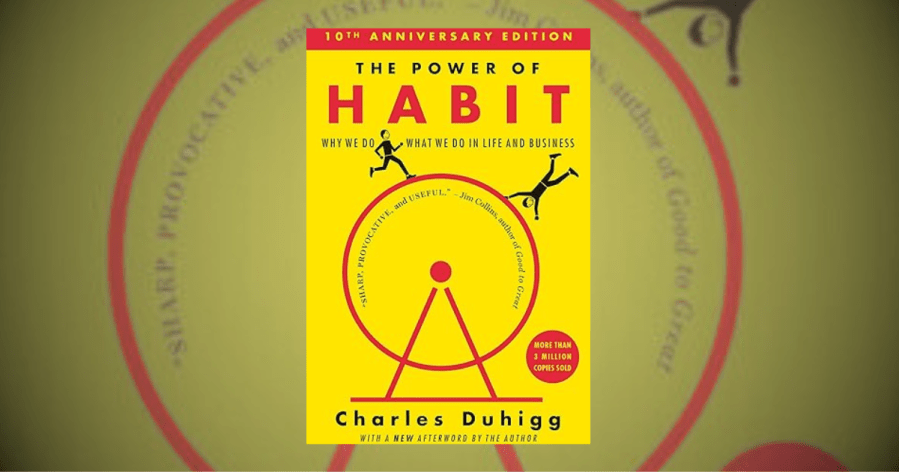
I recently read The Power of Habit, by New York Times reporter and author Charles Duhigg. In this best seller, he offers a deeper look at why we do what we do, as individuals, organizations, and societies.
According to Duhigg, it all comes down to our habits, or a cycle loop consisting of a cue (a plate of cookies), a routine (nom nom nom), and a reward (sugar high!)
Habits can be great because they let us go on autopilot for certain tasks and save our brain power for more complicated or creative endeavors. But it also means we can form bad habits just as easily as good ones, and go into zombie mode without realizing it.
So how does this relate back to you, and the books you love to read?
Your Brain on Habits
Our habits make us easy to predict, and they also make us crave the familiar whether we actually like it or not. This means we’re easy to manipulate, and everyone who wants to sell you something knows it, from your grocery store to retailers to (alas!) the publishing industry.
Duhigg illustrates this with an example from the music industry. According to a program called Hit Song Science – which uses a formula to predict if a song will be a hit or a flop – “Hey Ya!” should have blown up the charts when it was first released in 2003. Instead, it crashed, at least at first.
You’ll have to read the book to hear how DJs figured out how to make the song into a hit, but let’s imagine how similar programs are being utilized by the publishing industry.
You better believe they are combing through big data to understand our reading habits and how to best market to us and create formulas that are probably something like: strong female lead + troubled past + a love/hate romantic interest (or two) + dystopian setting + a secret supernatural power equals the next big YA fantasy hit.
But why is this bad, you might ask. Isn’t that wonderful that marketers, psychologists, and big data have all joined hands, probed our psyches and produced exactly what we want most? More of the stuff we love?
I would say it’s not that simple for a few reasons.
“Try blue – it’s the new red!”
First, I would say that this approach doesn’t guarantee us more great books – it just means we’ll get the same type of story that could actually be mediocre or just plain terrible, but we eat it up because it’s familiar.
Secondly, I would imagine these types of formulas make it much harder for non-mainstream authors or unusual stories to get published. And if they do, the story is undoubtedly churned through a formula, added to, and squeezed into a familiar shape so the final product ends up tasting more or less the same as everything else.
This stifles creativity, and makes aspiring writers have to choose between pandering to the whims of their audience, or letting their project fizzle out.
Fine, you say. But isn’t that what artists and creators have always had to do? Pander to the whims of patrons or the lowest common denominator?
Perhaps so, but predictive analytics takes us to a whole new level. Like the difference between taking the carriage into town, to jumping onto Elon Musk’s hyperloop to the moon.
And what happens when predictive analytics becomes manipulative analytics? Think – “Try blue – it’s the new red!” from the hit animation WALL-E. Why waste money figuring out what your audience wants when it’s so much easier to hook them on something that’s cheap and easy to mass produce?
Is there a balance?
To be fair, predicative analytics can do some good as well. Duhigg shares a few examples of how the Hit Song Science algorithm actually benefited some musicians by showing, via its formula, that songs that were doubted by producers would actually be hits (like Come Away with Me by Norah Jones).
Also, companies are not non-profits, they need to sell products to make money and stay in business. Predictive analytics can help them do that, and in this competitive market, if you’re not using big data, you’re probably not in the game. Programs like Hit Song Science might also be a huge help to small or medium-sized businesses who don’t have the ability to take a risk on something that might not sell.
In the end, predictive analytics is just a tool that can be good or bad depending on how we wield it.
I wonder though, would Bach have been famous during his lifetime if Hit Song Science had been around? Would controversial books like Lolita, or Catcher in the Rye have made the cut using whatever formulas are being used today?
In an ideal world it would be lovely if publishing industries used predictive analytics to give them the financial stability they would need to be able to take risks on the new, the unusual, the controversial, and the experimental. Instead of just seeking out authors who already look the part, they could use predictive analytics to back up decisions to invest in unlikely authors.
What if we approached these tools as an art, not a magic formula, and used them to inform, but not make, our decisions?
Some final thoughts
To keep yourself from being a book zombie, here are some ways to shake things up – and lob in a few outliers into whatever “Hit Reading Science” machine is out there analyzing your reading habits. 😉
- Read something you usually wouldn’t go for. Get recommendations from someone who actually loves that genre. Explore the subgenres!
- Read a book that won awards but didn’t get great reviews on GoodReads or Amazon.
- Support lesser-known or new authors:
- Patreon – crowdfunding for artists
- Swoon Reads – crowd sourced publishing
- 7 Ways to Support Your Favorite Authors (Book Riot)
 Booklight Reviews