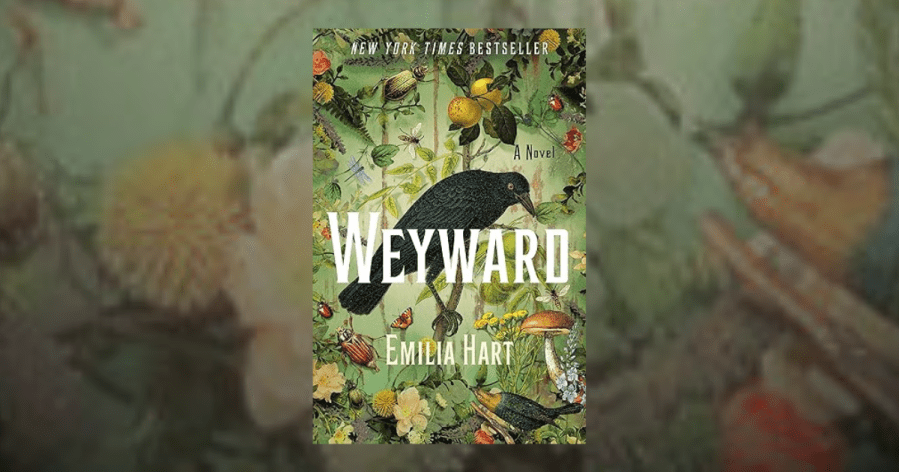
I recently read the first few chapters of Weyward by Emilia Hart, and it got me thinking about how much the Point of View can impact a story.
Hart made an unusual choice to change the Point of View (POV) for each character, and use both present and past tense, so each character’s chapters sound distinct.
[WARNING: This content contains spoilers]
Weyward is told through shifting perspectives of three women from different points in time. There is Altha (1619), being accused of being a witch; Kate (2019), a young, pregnant woman escaping an abusive relationship; and Violet (1942), a teenager being raised in a rural English manor by an oppressive father.
Here is a simple reminder of what POV is (and here is a more detailed Reedsy post with examples):
- First person is told with “I, me, my” – I made myself a sandwich.
- Second person is told with “you, yourself” – You made yourself a sandwich.
- Third person is told with “she/he/they/it” – She made herself a sandwich.
In Weyward, Altha’s POV (1619) is told in first-person present tense, Kate’s (2019) is third-person present tense, and Violet (1942) is told in third-person, past-tense, meaning no two characters sound quite the same.
I think this is a bold and interesting choice, but there is a reason most authors don’t attempt to mix and match to this extent.
Frequently changing POVs can create a disjointed feeling as the reader is jumped from character to character, like a rushed game of speed dating. Or we end up liking one character’s voice more than another’s and impatiently skim over chapters to get back to “the real story.”
Before I address how Hart might have avoided these common pitfalls while still playing with POV and tense, let’s look at it a bit closer and speculate on what she was hoping to accomplish.
Altha (1619): First Person POV, Present Tense
Using first-person is intimate, it helps you feel the emotions and physical experiences of a character in a visceral way, it’s as if you’re in their body and head. This POV makes sense for Altha, because it helps the reader feel the terror and helplessness of being a woman in the 17th century on trial for witchcraft. It brings us closest to the life the character whose story is furthest away from us in time, and perhaps harder to relate to.
Footsteps. Then, the wrench of metal on metal, as the bolt was drawn back. The light hurt my eyes. For a moment the men in the doorway shimmered as if they were not of this world, and had come to take me away from it.
Altha (1619)
Kate (2019): Third Person POV, Present Tense
Kate on the other hand, uses third-person, present tense. Present tense records what is happening to the character as they speak (“Kate makes herself a sandwich” vs Past tense, “Kate made herself a sandwich”). While becoming more popular, is still a less common, and therefore a noticeable stylistic choice.
Present tense, especially in third person, can sound unusual to our ears, even jarring. It can enhance a feeling of eeriness, or anticipation, which might work particularly well for a mystery, sci-fi, horror, or thriller. I also see it used well in small doses, such as in prologues, or interludes that spotlight a side character (especially a villain). Neil Gaiman uses this in a few interludes in American Gods.
In theory, I can see the reasoning for choosing this for Kate’s perspective. She is escaping an abusive husband and is in a fight-or-flight, survival mode situation, and hearing her story as it is happening can increase tension.
Kate is staring in the mirror when she hears it. The key, scraping in the lock. Her fingers shake as she hurries to fix her makeup, dark threads of mascara spidering onto her lower lids.
Kate (2019)
However, the present tense runs the risk of taking the reader out of the story because it is less common and more distracting, and this was exacerbated in Weyward due to the amount of POVs and tense changes.
Violet (1942): Third Person POV, Past Tense
And then there is Violet’s story, told in the most traditional, most common third-person, past tense.
I didn’t finish the book, so I’m not sure why that was the choice. I’m guessing Violet learns that she has some supernatural powers, and if that’s the case, the third-person limited POV can be helpful when you want to create anticipation by allowing the reader to figure out something about a character before the character is aware of it themselves.
“Do I look like my mother?” Violet had been asking for as long as she could remember. There were no pictures of her mother. All she had of her was an old necklace with a dented oval pendant.
Violet (1942)
Simplifying Weyward for a smoother read
We can see that there are some compelling reasons Hart chose the above POVs and tenses for each character.
So, why didn’t it work?
First, we must remember that telling a story with multiple characters’ perspectives, and/or changing POV type or tense between characters, will always slow down your story and change the rhythm, no matter how well the story is written.
That is not to say that you shouldn’t do it, or that you story will feel slow or jarring because you do this. It is simply something to account for, the way you need to account for how different cooking methods lead to different results. Swap out white sugar for honey and you get a different depth of flavor, more moisture, etc. and you must account for it, depending on the result you want.
Rotating POVs can be a great tool for creating tension, suspense, and anticipation as readers are forced to wait to see what happens next. It can add nuance and depth to your story by demonstrating how characters experience the same situation in different ways. It can help you develop subplots or tell a story across physical distances or time.
But each time your switch a character, POV, or tense, you will alter the rhythm, and if it is not done well or judiciously, it can feel disrupting. They will resurface from their author guided daydream, and it will take time to sink back into the story.
In Weyward, rotating every single chapter between three characters, and changing the POV, and changing the tense ended up distracting from and ultimately weakening the story.
It would have been smoother and more enjoyable if Hart would have focused in on one or two of the characters and used the other(s) to supplement the main storyline. Which, to be fair, it seems she does somewhat – I can see by flipping through the book that Altha’s chapters are much shorter. They read like interludes, and they should have been included as such, and not given the same frequency as the other characters.
For example, it would have felt more balanced if Violet and Kate would have both been in the more common, less noticeable third person, past tense. Then Altha’s shorter chapters, told in a first-person present tense, would have really stood out. When every character’s POV jumps out at you, it’s like having an imbalanced three course meal where each plate is full of unusual, intense flavors – they end up not meshing and even overpowering the senses.
So instead of this for the chapter structure:
Altha – Kate – Violet – Altha – Kate – Violet – Altha – Kate – Violet
We could have something like this:
Altha interlude – Kate – Violet – Kate – Violet – Kate – Violet
Or this:
Altha interlude – Kate – Kate – Violet – Kate – Kate – Violet
Creating connections with characters
The other reason rotating characters can be a gamble is that it doesn’t give readers as much time with any one character to begin to know them or root for them. If you’ve heard about Save the Cat, you can see why this is critical. So, if you’re going to rotate characters and often, you need to create that connection, and fast.
I felt this needed the most work with Kate’s character. Even after a few chapters, her character still felt two-dimensional. I was especially put off by the intensity and darkness of her chapters. I understand she was fleeing domestic violence, with is dark and intense, but without sharing anything else about her and her husband as people, it felt like the story was using shock value to force an emotional response.
To temper this, the author could have used a flashback or alluded to a memory. For example, Kate could pause as she deliberates over packing a teddy bear Simon won for her at a fair on their first date. Or, a photo on the fridge could catch her eye, and she takes it down to trace the faces of the happy couple with all their friends at a ski lodge, and she thinks that it is like looking at a different life even though it was only two year ago.
Show us, even, Simon’s humanity. I’m not saying we should have sympathy for him, but providing even a few hints of an antagonist’s backstory can give a story more depth.
For example, as Kate drives to Weyward she could see a sweet couple holding hands at a diner, and it reminds her of the first time Simon opened up about his family, how he hinted at a strained relationship with his step-father, and dark look passed over his face, or he clenched his fists (or some kind of red flag).
Your Thoughts?
What did you think of the switching character POVs in Weyward? Are there any books you’ve read that do this well? What books would have benefited from changing something about their POV or tense choice, or the frequency/order of character perspectives?
What did you choose for your own story, and why?
 Booklight Reviews
Pingback: Alternatives to Dual Timelines for Complex Narratives: Witch King Review – Booklight Reviews