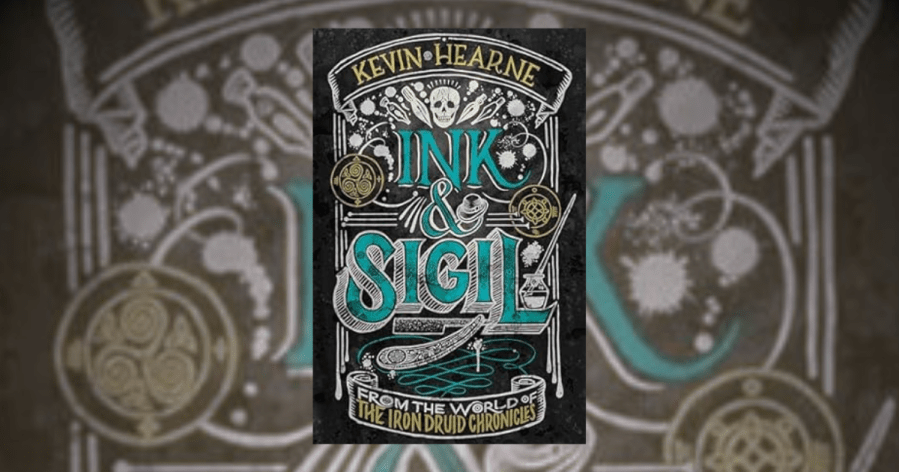
Ink & Sigil by Kevin Hearne was a fun, fast-paced read set in a magical version of Scotland. It follows the misadventures of an endearing curmudgeon and Sigil Agent, Al MacBharrais, who reads like a ready-to-retire Sherlock Holmes who’s just a little bit depressed.
Along with his lovably lewd hobgoblin sidekick Buck Foi (yes, really), they go on a winding adventure to figure out what MacBharrais’s apprentice was mixed up in before he died.
Even though the dark humor and mix of violent (often just gross) scenes made this not my type of book, I think it was overall very well done and would be a great fit for any fan of detective or mystery-action stories along the lines of the movies Crank or Fight Club.
Humorous Pronunciation Guide
The book opens with a short Author’s Note that serves as a pronunciation guide for the Scottish words used throughout the story.
Typically, I don’t like introductory material before chapter 1 unless it’s dedication, poem, quote, or prologue, but this was an exception. Written with the same snappy, cheeky tone as the rest of the book, Hearne makes the guide both helpful and entertaining:
“In other constructions where the contraction cannae be made, the t will be dropped off the end of not, and thus you will see phrases like she’ll no ever come back or I’m no paying for ma drink or I’m no gonnay get in the van with ye, ya spooky serial killin’ bastard.”
I think another reason guide works so well is that it truly is essential (unlike most intro Author’s Notes I encounter) to fully immersing yourself in the story because it primes you to hear the local dialect of the characters’ voices accurately, which is crucial to the humor of the book as well as creating an authentic sense of place.
Glaswegian Dialogue, Neutral English Narration
This leads to another interesting and surprisingly effective decision Hearne makes to write the story from first person POV.
The dialogue in Ink & Sigil is thick with the distinct Glaswegian accent – ye’s instead of you, didnae’s instead of didn’t, ma instead of my, etc.
However, the story is narrated by MacBharrais, and his first person POV reads like your standard educated English man, though the same sarcastic observations still come through.
This choice surprised me, because at first glance it might have been easier to tell the story from third person POV, which would have made the “voice jumping” from MacBharrais’s thick accent to his neutral English narration less apparent.
“A little sumhin for the road – but take it tae go, eh? I do no want tae listen to yer slobbery gob macking the shite out of some poor coo’s remains.” I went to the mini-fridge, which did in fact contain the ice I’d promised Buck if wanted any but also contained a sirloin roast wrapped in paper. I unwrapped it and tossed it in the air to the barghest, which caught it neatly with its jaws.”
But even though third person might have been less noticeable, the first-person POV was the better choice.
For one, this is very common in detective stories because it limits what the reader knows and makes you feel as if you are unraveling the story with the detective. It also worked because the wry humor is essential to the story. Even though MacBharrais’s narrator voice sounds completely different than his speaking voice, the humor was consistent.
If Hearne had written the whole story in an authentically Glaswegian accent it would have been unreadable, and third person wouldn’t have been able to capture the same humor.
Visually Conveying Text or Type
Another small part of the puzzle is MacBharrais’s mysterious curse that causes anyone he speaks to for too long to hate him. As a result, he frequently communicates with a text-to-speech device which is visually conveyed to readers using bracketed phrases.
If I had one minor complaint, it would be the decision to put MacBharrais’s text-to-speech words in brackets.
[Can you trace the origin of Bastille’s emails?]
“I can try, but I’ll bet you six biscuits it’s just a bunch of proxies.”
[Can you get into Gordie’s phone and get his contacts and calls?]
“Aye. Androids are easy. I mean, it’ll take a while, don’t get me wrong, but I’ll get it done.”
I think the curse and text-to-speech as a plot device is fine, but the brackets were distracting. Each time I saw one my brain hiccuped just a little. It would have been smoother to try some other methods, like using italics, or using a different computer-y font.
For example, Hearne could have used Roboto, a common Android texting font. Perhaps even indenting it a bit would help. I’ll use Garamond as the default font to stay in keeping with what was used in the book to show what this visually would look like:

It’s funny that Hearne didn’t utilize this strategy, when elsewhere in the book he does use a sans-serif font to show email text, and also italics to show regular phone texts. Perhaps he was trying to keep it all separate, but as the text-to-speech played a pretty big role, I found it awkward and unnecessary.
Sigil & Ink Magic System
However, I was also impressed with the general worldbuilding and the sigil and ink magic system.
MacBharrais is a Sigil Agent, using his rare abilities and training to draw sigils – symbols with magical properties – to protect the human world from the host of otherworldly creatures from different planes.
The sigils allow the wielder special properties (if used for themselves) or influence over others such as the Sigil of Porous Minds to make people forgetful and suggestible, Sigil of Swallowed Light, Sigil of Dampening Magic, and even a Sigil of Sexual Vigor.
The symbols’ power is also dependent on the type of ink that is used, made up of curious ingredients like “ground pearls, fish glue, and vitreous jelly of owl eyes,” and “pine soot with finely ground bits of stag-beetle carapace . . .”
In Hearne’s back of the book acknowledgments, he mentions he drew some inspiration from Ink by Ted Bishop, which I immediately bought a copy of to learn more about the strange history of ink making.
I also liked the little bit of sigil lore Hearne built in, with the origin of sigils and ink being bestowed upon humanity by Brighid, the First among the Fae. But later in the book, he also mentions that the eastern practitioners have “their own sets of inks and sigils, since they had a different, older system invented by Chinese deities, and their inks were solid ink sticks rather than liquid.”
A small yet brilliant detail that hopefully will be expanded upon in the later books in series.
Moral Messages & Intrusive Author Voice
Hearne also manages to tie in a bigger picture message about human (or in this case, Fae) trafficking.
I generally dislike it when authors insert sermonizing messages disguised as dialogue or observation into stories because it almost always feels like the author is briefly possessing their character’s voice to have a soapbox about a particular issue.
And while the long, didactic conversation between MacBharrais and his associate Saxon in Chapter 3 was no different, I didn’t mind it.
Trafficking is a horrifyingly real issue around the world and in the United States, and I think it’s great Hearne put a spotlight on it, especially since I’m guessing his audience is male-based.
But what are some ways authors can incorporate a moral message without being so on the nose?
- Hearne could have shortened the dialogue in that section by about half, keeping enough to give us some context, but then using the plot to show the reader the horrors of trafficking. He already did this with Buck’s story, as well as a pixie’s situation at the end.
- He could have also had MacBharrais overhear a disturbing conversation between traffickers, witness the treatment of a victim firsthand, discover evidence of trafficking (video footage, ledgers, emails, etc.) I think most of this did actually happen, and it was sufficient.
- Create believable, natural dialogue through opposing viewpoints of characters, or characters showing genuine curiosity. Hearne tries to use the latter in the Chapter 3 conversation, but it feels forced, with MacBharrais going on prompt auto-pilot, asking Saxon question after bracketed question:
- [What you were saying earlier. About focusing human trafficking on the sex or labor industries. How do they go about it?]
- [So who’s demanding modern slavery?]
- [How can they not?]
- [Seriously?]
- [Are you having a laugh at me now?]
- [So how do we stop it?]
- [How so?]
I think more detailed context about a book’s issue is often best saved at the end of a book in places like the Author’s Note, Acknowledgments, interviews, or a Question Guide.
In Conclusion
With witty dark humor, a unique magic system, and a ridiculous, vulgar, and hilarious cast of characters, Ink & Sigil was a well-paced and entertaining story with a solid message.
Even though it wasn’t for me, I am glad I read it as an excellent example of the detective-action genre, the first person POV, and writing a story where a distinct accent is essential to the setting and characters.
Your Comments?
What are your thoughts on before-the-book Author’s Notes?
What books do a good job using accents or colloquialism to create an authentic sense of place?
Does your book have a morale message, and if so, what strategies are you using to work it into the story?
 Booklight Reviews